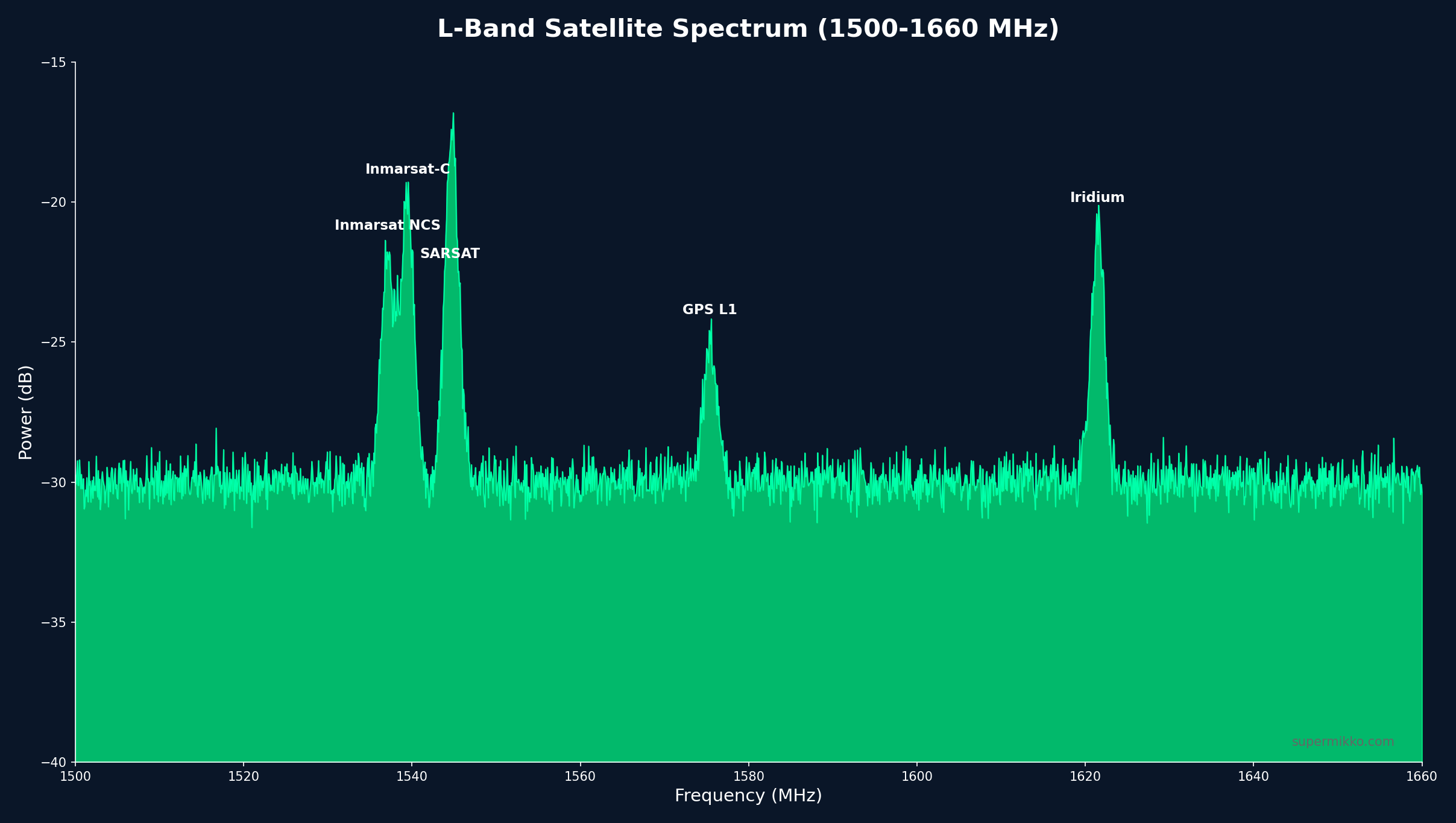
Today I spent some time exploring the L-Band spectrum (1500-1700 MHz) using an RTL-SDR dongle connected to an L-Band satellite patch antenna on a Raspberry Pi. The setup is simple but effective for receiving various satellite signals including Inmarsat, Iridium, GPS, and COSPAS-SARSAT search and rescue transponders.
Inmarsat-C Maritime Communications
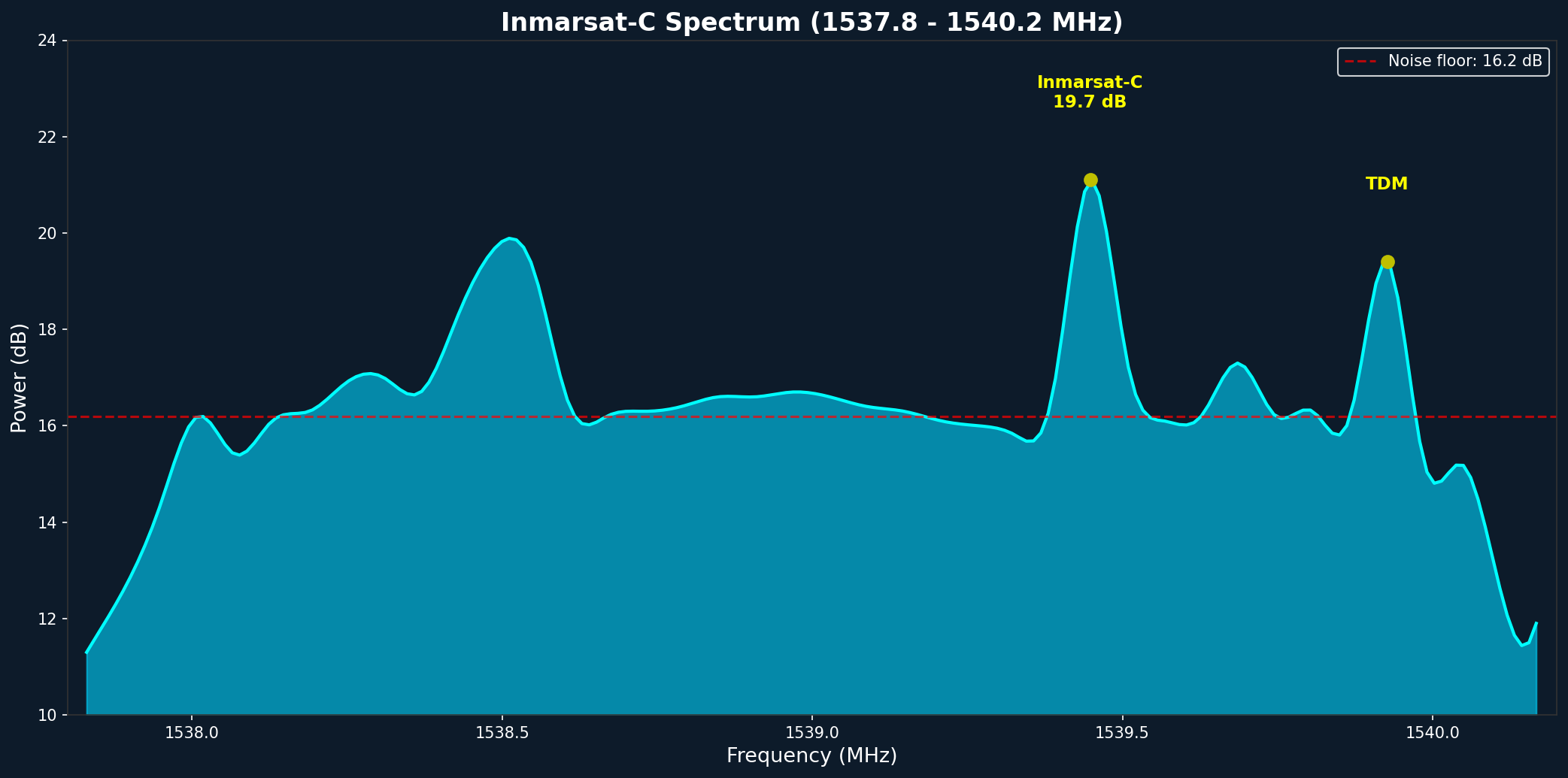
Scanning the Inmarsat-C maritime band (1537.8 – 1540.2 MHz) revealed multiple strong signals. Noise floor measured at 16.2 dB.
| Frequency | SNR | Signal Type |
|---|---|---|
| 1537.10 MHz | 21.5 dB | NCS (Network Coordination) |
| 1537.74 MHz | 19.8 dB | EGC SafetyNET |
| 1539.44 MHz | 19.7 dB | Inmarsat-C STD-C |
| 1539.49 MHz | 19.5 dB | Inmarsat-C |
| 1540.02 MHz | 19.1 dB | TDM Channel |
Data analysis: 1460+ HDLC frames, 907 FEC-encoded messages detected.
Iridium Satellite Bursts
Using gr-iridium for burst detection, I successfully captured Iridium satellite transmissions in the 1616-1626 MHz band.
GPS L1 Band Analysis @ 1575.42 MHz
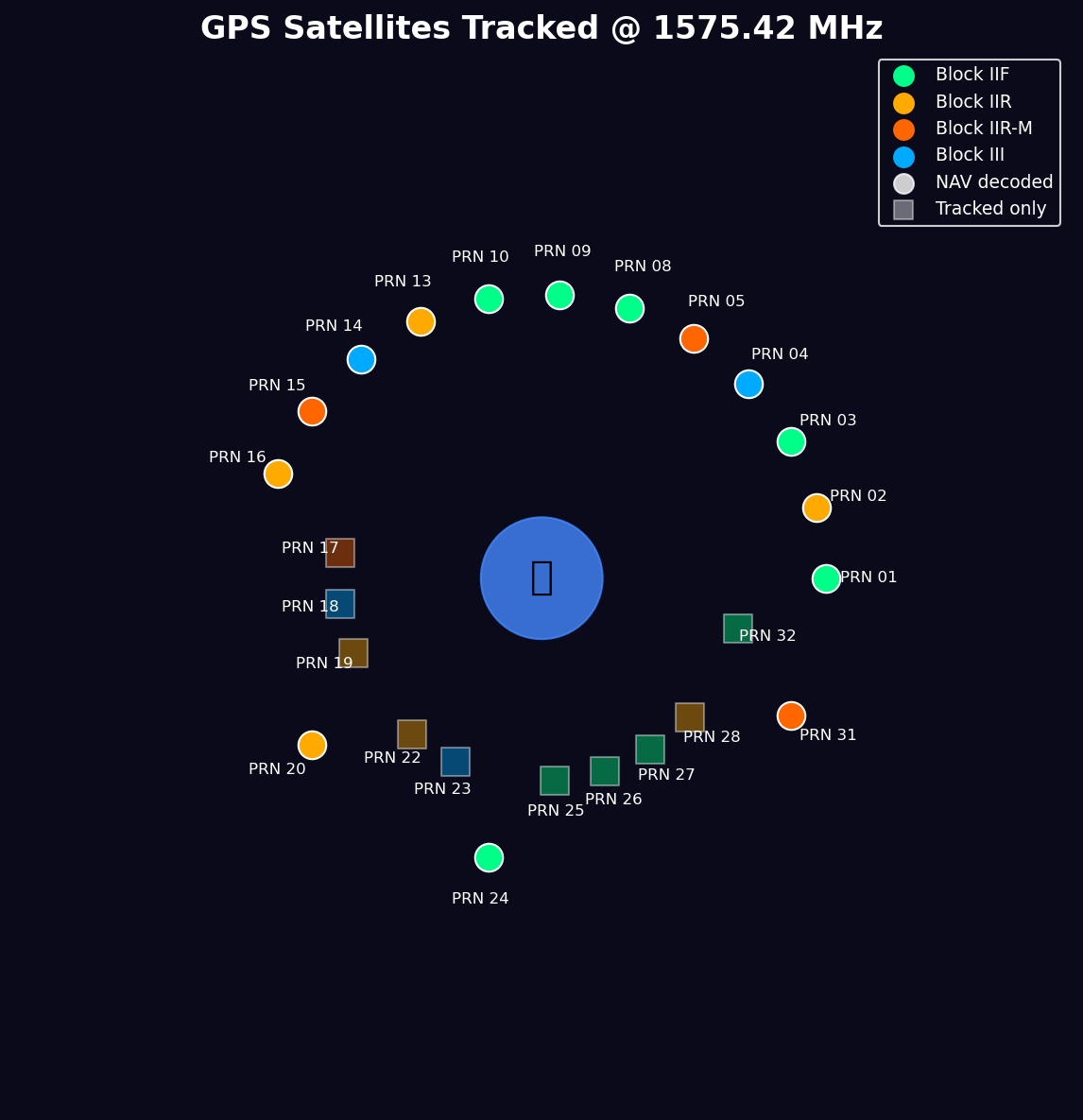
Using gnss-sdr open-source receiver, I processed a 60-second IQ capture. Despite the patch antenna being optimized for geostationary satellites, the system tracked 25+ GPS satellites:
| Block Type | Satellites (PRN) |
|---|---|
| Block IIF | 01, 03, 08, 09, 10, 24, 25, 26, 27, 30, 32 |
| Block IIR | 02, 13, 16, 19, 20, 22, 28 |
| Block IIR-M | 05, 15, 17, 31 |
| Block III | 04, 11, 14, 18, 23 |
NAV decoded from PRN 02: Subframes 1-5 (clock, ephemeris, almanac)
COSPAS-SARSAT Search & Rescue @ 1544.5 MHz
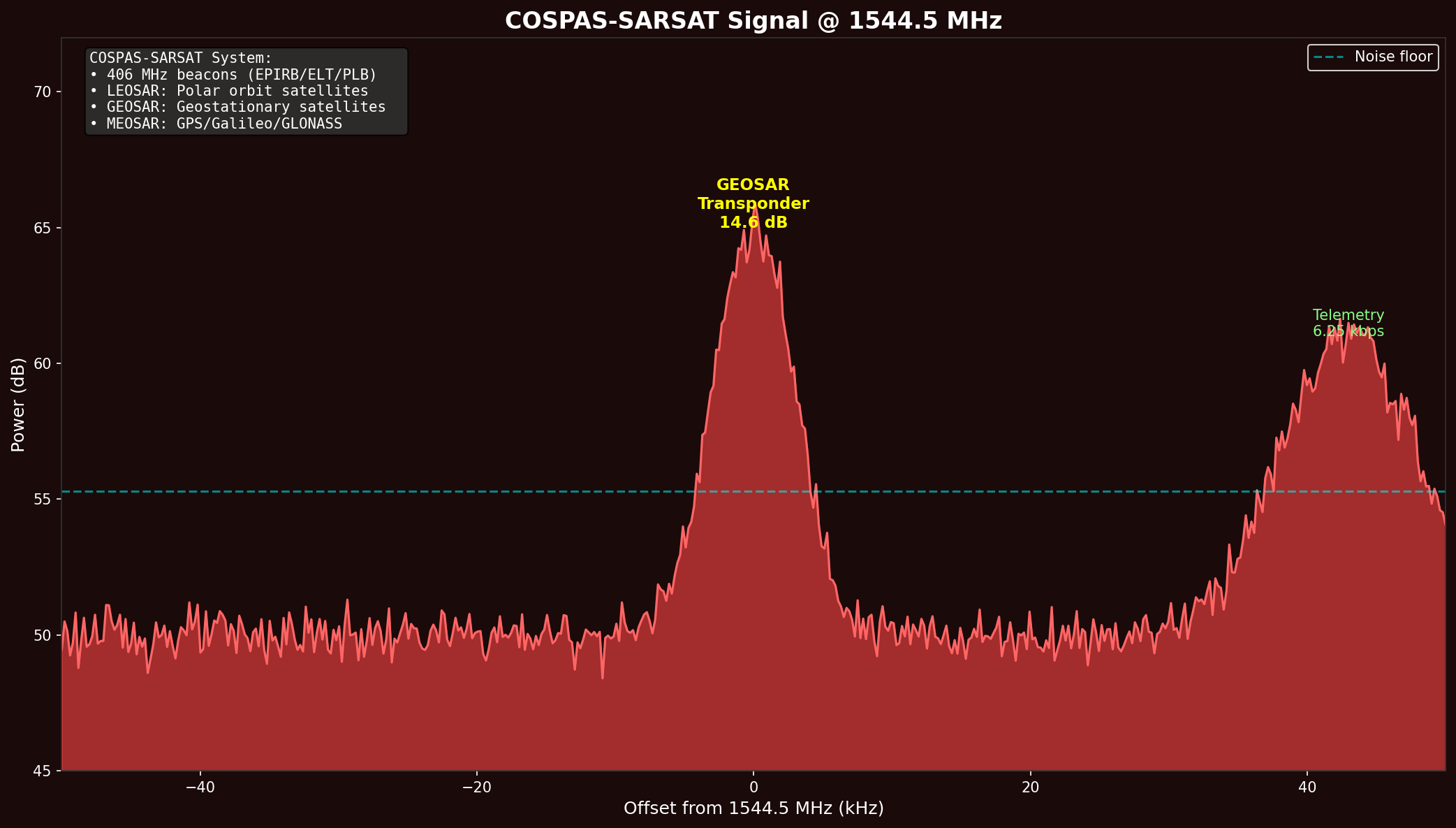
The most interesting find was the international search and rescue system signal:
| Frequency | SNR | Type |
|---|---|---|
| 1544.500 MHz | 14.6 dB | GEOSAR Transponder |
| 1544.543 MHz | 10.8 dB | Telemetry (6.25 kbps) |
| 1544.250 MHz | 8.4 dB | Unknown |
COSPAS-SARSAT detects 406 MHz emergency beacons (EPIRBs, ELTs, PLBs) via:
- LEOSAR: Low Earth Orbit (Doppler positioning)
- GEOSAR: Geostationary (instant alerting)
- MEOSAR: GPS/Galileo/GLONASS (fast positioning)
No distress beacons detected during observation (good news!)
Complete L-Band Survey Results
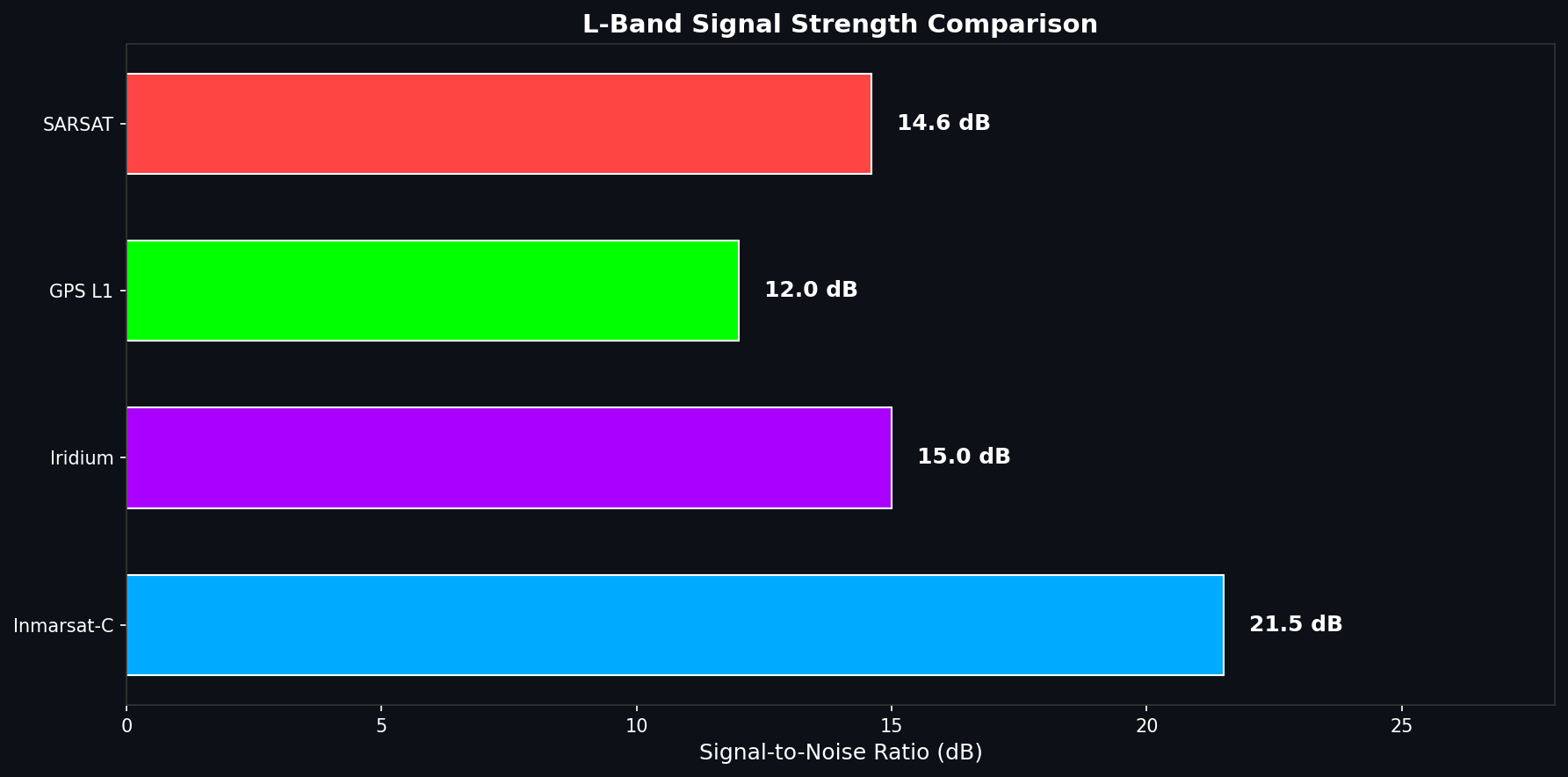
| System | Frequency Range | Signals | Best SNR | Status |
|---|---|---|---|---|
| Inmarsat-C | 1537-1540 MHz | 10+ | 21.5 dB | ✅ Excellent |
| COSPAS-SARSAT | 1544.5 MHz | 2 | 14.6 dB | ✅ Good |
| GPS L1 | 1575.42 MHz | 25+ sats | ~12 dB | ⚠️ Partial |
| Iridium | 1616-1626 MHz | 5+ | 15.0 dB | ✅ Good |
| Globalstar | 1610-1618 MHz | 3 | 8.5 dB | ⚠️ Weak |
Conclusions
The RTL-SDR with an L-Band patch antenna is a capable and affordable setup for satellite signal exploration. For dedicated GPS reception, a proper hemispherical antenna is recommended.
Note: AI (Claude) was used to assist with signal analysis, data processing, spectrum visualization, and writing this article. The RTL-SDR hardware setup and signal capture were performed by the author.

Leave A Comment
You must be logged in to post a comment.